


Skip to content

The learning
operating system.

Record a lecture. Work through an idea. Study it together. Your notes, Airboard, Groups, and research—in one place.

Your study workspace
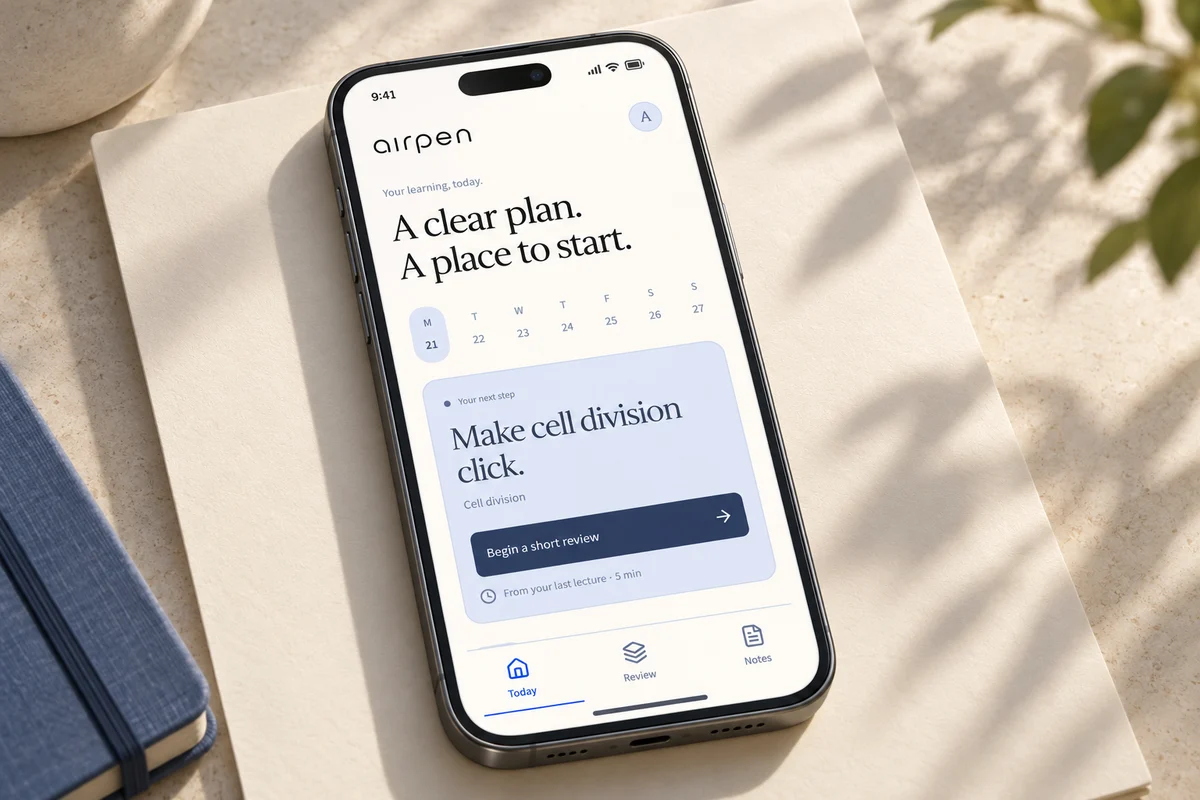
My learning Today

Your next best step

Know what needs work.
Start there.

Monday
21
Biology10 min

Make cell division click.

A short review of the ideas from your last lecture. A good place to begin today.

Keep going, at your own pace.
Attention & memoryPsychology · Lecture notes
Ready to revisit
A question worth followingResearch · Reading collection
One place.A clearer next step.

A lecture is only the beginning.

The notes. The questions.
The moment it makes sense.

Bring your lectures, study group, and research into one place.
Go from keeping the material to working through it.

01 / Lecture capture

Listen to the lecture.
Keep learning after it.

Turn the explanation into study notes. Test what you remember. Come back knowing what to work on next.

African American university students listening to a lecture, with a laptop and a phone displaying an audio waveform on the desk
AirpenLecture capture
Biology 201

Stay with the explanation.

Recording example
  1. Capture the explanation.

    Record or upload the lecture so you can return to what matters.

  2. Find the key ideas.

    Study notes give the material a shape you can work with.

  3. See what you remember.

    Use questions and flashcards to put your understanding to work.

  4. Know where to return.

    Bring due reviews and weaker topics into your next study session.

02 / Your study plan

Know what to
study next.

Five subjects. A growing pile of notes. One place to begin.

Airpen brings due reviews, weaker topics, and your next course step into a daily plan. See what needs your attention—and why.

Try a little practice
Your study dayExample plan
  1. 01
    Revisit what’s due.Biology · Cell division
    Now
  2. 02
    Work on a weaker topic.Physics · Forces and motion
  3. 03
    Take the next course step.Statistics · Sampling
Biology · Cell division

A little recall. A clearer idea.

Return to the ideas from your last biology lecture. Start with what you can recall, then check your notes.

Why this comes first

These cards are due for review. Revisit them before moving on to a new topic.

5-minute review

An interactive example. A small step you can try right here.

03 / Groups

Good questions.
Better together.

A place for the people you study with. Bring your sources, talk through a problem, and keep the notes and practice after the session.

Four African American university students working through a question together around a study table
Biology study groupSession recap

What we worked through.

Cell division · DNA replication · The questions to revisit

Shared study notePractice questions
04 / Airboard

Don’t just read it.
Work it out.

See the idea. Follow the workings. Check your answer. Airboard gives a difficult concept somewhere to become clear.

AirboardPhysics / Forces
Step 1 of 3

Start with what you know.

F = ma

Force equals mass × acceleration. Our object has a mass of 2 kg and accelerates at 3 m/s².

Interactive example · Your work, step by step.

05 / Research Studio

Your argument.
With the evidence behind it.

Collect sources. Read closely. Connect the evidence to your draft. Keep the path from an idea to its source clear.

Explore the research workspace
Research StudioStudy methods

What helps an idea stay with us?

01 / Collect

Keep the sources in view.

Papers, lecture notes, and the passages you want to return to.

02 / Connect

What does the evidence support?

Compare findings. Record the limits. Link each point to its source.

03 / Write

Make the argument yours.

Your outline, your reasoning, and citations you can trace.

One Airpen. Wherever you learn.

At your desk.
Out in the world.

Study on the web or your phone. Capture in Chrome.
One learning path across the tools you use.

Learning support, at your pace.

Start with curiosity.
Make room to grow.

Start with one lecture. Build a daily rhythm. Go deeper into your work.
Choose the support that fits your learning.

Monthly plans · USD

Free

Bring your first notes into a learning path.

$0/ month

No card required

Start with one lecture.

  • 30 transcription minutes to get started, once
  • 25 study credits each month
  • 250 MB for your files

Focus

More room for lectures, practice, and your next step.

$9.99/ month

Per person · processing fees extra

Build your daily study rhythm.

  • 300 transcription minutes each month
  • 150 study credits each month
  • 2 GB for your files

Scholar

More capacity for a full course load.

$19.99/ month

Per person · processing fees extra

Go deeper into your work.

  • 900 transcription minutes each month
  • 350 study credits each month
  • 10 GB for your files

One learning system.

Notes, practice, research, and your next step. Start free and upgrade when you need more capacity.

Clear limits. Your choice.

Study credits cover new explanations, practice, and research. Revisiting saved work uses no new credits. No automatic paid overages.

Choose a paid plan to continue to secure checkout after signing in. Payment requires your confirmation. Any test checkout is clearly marked and collects no real money. Check Billing for your current access. Processing fees are extra, and video is separately funded.

Learning, together.

Exploring Airpen for your class or institution? Tell us what your learners need.

Talk to our team

Before you begin.

Good questions.
Clear answers.

Still curious?
Talk to the people building Airpen.

The Airpen thesis.

Learning has never been short of information.
It has been short of guidance.

Bring your notes, questions, and practice together. Give the effort you already put in a clearer direction.

Get started